
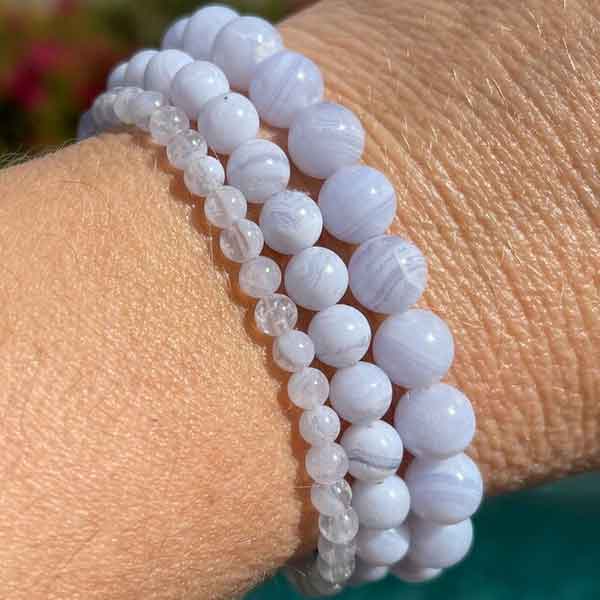
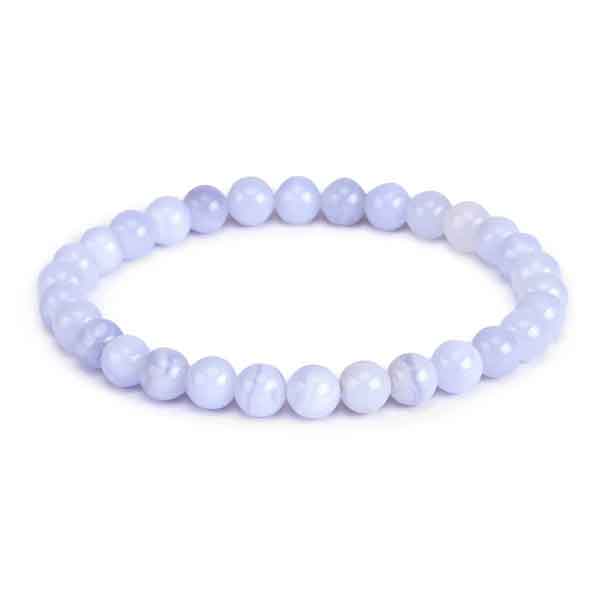
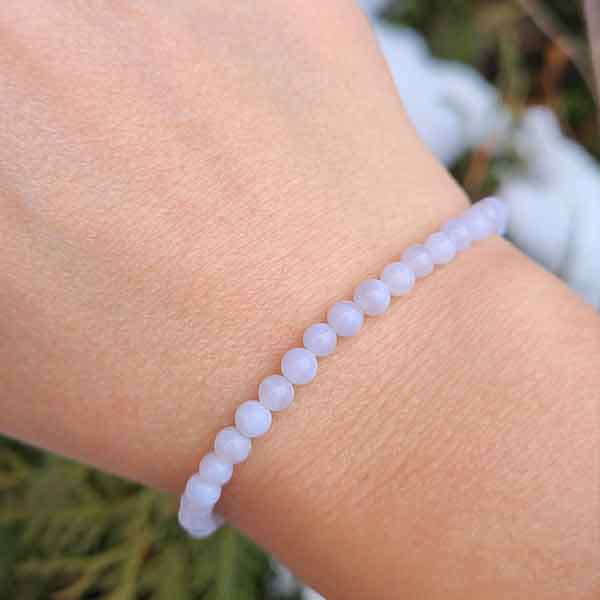
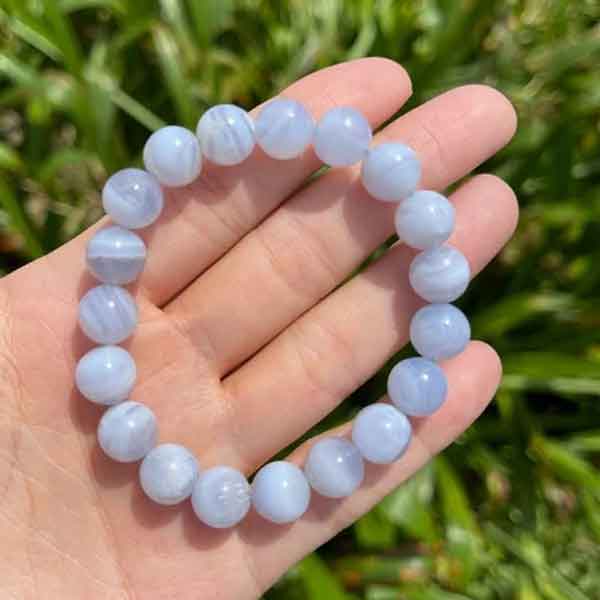


Blue Lace Agate, Handmade Stretch Bracelet, Natural Stone, Class A
Price range: 10.79€ through 13.13€
- Blue Lace Agate, natural stone, material origin India
Blue Lace Agate,
Handmade Stretch Bracelet, Natural Stone, Class A
Blue Lace Agate is a very beautiful, gentle and magical stone.
It is a variety of Agate distinguished by its delicate blue shades intertwined with white bands resembling lace, which is where its name comes from. This stone is a symbol of calm and peace, offering soothing energy that helps reduce stress and tension.
Blue Lace Agate is believed to have:
- Soothing energy: Blue Lace Agate is known for its ability to bring calm and peace to the mind, thereby helping to reduce stress and anxiety.
- Improved communication: This stone is considered a powerful tool for improving communication skills, encouraging clarity of expression and helping people express their thoughts and feelings more easily and effectively.
- Emotional healing: Blue Lace Agate can help in the process of emotional healing, offering comfort and support in overcoming old emotional traumas.
- Stimulating creativity: The stone is believed to stimulate creative and artistic expression, thereby encouraging imagination and innovative thinking.
- Grounding and balancing: Despite its gentle energy, Blue Lace Agate helps ground and balance emotions, creating a sense of stability and inner peace.
- Support during meditation: Thanks to its soothing energy, Blue Lace Agate is an excellent stone for meditation, helping practitioners reach deeper levels of relaxation and awareness.
Blue Lace Agate is ideal for people seeking calm and harmony in their lives, as well as for those who want to improve their communication skills and emotional well-being.
Agate
Agate is associated with Mercury. It strengthens willpower and sensitivity in Virgo, Taurus, Gemini and Capricorn. The different colors can be used by all zodiac signs.
Chakras: Agate with predominantly red tones – sacral; gray and blue – throat
Hardness: 6.5 – 7.
Color: Agate occurs in all kinds of colors and shades. Agates have been artificially colored since antiquity. Through chemical treatment, black, green, blue or violet band colors can be achieved, while red can be intensified. Thanks to its ability to change color through chemical and heat treatment, today there is an entire industry devoted to producing chemically colored stones.
Deposits: Found throughout the world – India, Brazil, Uruguay, Mexico, USA. Huge quantities of Agate are imported from some Latin American countries such as Brazil and Paraguay. High-quality specimens are also found in the Deccan Plateau in India. The Idar-Oberstein region (Southwestern Germany) is world-famous for its Agate deposits. In Bulgaria – along the Arda River, in the Momchilgrad and Krumovgrad regions. In Bulgaria, the classic type is most often found in gray-white; Moss Agates are predominantly green, while Landscape Agates abound in yellow, green, red, brown and other colors.
Chemical composition: silicon dioxide with various impurities.
Description: Their forms vary – they occur as veins, flow formations, geodes, amygdules and more. All Agates are varieties of quartz, also known as chalcedony. The cryptocrystalline fibers characteristic of the stone can only be seen under a microscope. The bands may be arranged concentrically (classic Agate type), parallel (Uruguayan type or Onyx), may combine both types, or form various unusual images that often resemble landscapes (Landscape Agate) or fine algae in water (Moss Agate). Agates often contain inclusions of Opal and Celadonite or occur in combination with Clear Quartz and Amethyst. Their coloring is due to various oxides within them.
History and legends: Many legends are connected with Agates. They have been known to humankind since deep antiquity. In many cultures they were used in art and medicine. They were often described as stimulators of intuition, guardians of friendship and protection against evil forces.
The name most likely comes from the Achates River in Sicily. Today the river is called Dirillo.
In Ancient Greece, Agate was especially respected by sailors. It was believed that anyone who wore Agate would be protected from seasickness, and that wearing it as a pendant around the neck or as an Agate ring would bring peace, deep sleep, good health, a long life and a good-natured character. This tradition most likely originated in Egypt.
In Rome the yellow-red Agate, called “lion Agate,” was the stone of gladiators because it was believed not only to bring them victory but also to attract women’s love. In the fifth book of the multi-volume “Materia Medica,” the ancient author Dioscorides describes more than two hundred crystals, including Agate, which was used for medicinal purposes by Roman physicians. They prescribed a remedy made from powdered Agate and sweet fruit juice for insanity, ulcers, boils, diseased kidneys and spleen. Some varieties were used for hemorrhoids and to fight the plague and other epidemic diseases. An Agate pendant was recommended for indigestion, lung diseases and unexplained fears.
Followers of Islam engrave Agates with symbols of the Prophet’s grandsons and hang them around children’s necks to protect them from falls and accidents. Many Muslims wear necklaces of multicolored Agates. In the Arab world it was believed that red Agate (also called “blood Agate”) protected against scorpion and spider bites. Green Agate was highly valued because it was believed to protect against all kinds of eye diseases.
Ancient Hebrew folklore also claims that Agate protects against stumbling and falling. For centuries horsemen believed this and braided Agates into horses’ manes or reins. Most likely, the legend that Agate protected animals from stumbling changed somewhat when it was brought to Europe. Here peasants tied Agates to ox harnesses or horse tack while plowing their fields – it was believed they would bring an abundant harvest.
In 16th-century Italy it was believed that Agate repelled lightning and the destructive force of storms.
The Vikings and Saxons in England searched for lost objects and buried treasure using a double-edged axe and a round piece of Agate. They also used the stone for a form of magical divination called “axinomancy.” They heated the axe until it was red-hot, then drove the handle into the ground so that it stood upright. The round piece of Agate was placed on the heated axe head. If it fell and rolled in a direction, they would search that way. If it stuck, what they were looking for was considered too far from that place. A 10th-century Anglo-Saxon manuscript recommends Agate as protection against the devil. In the “Book of Saxon Leechcraft,” written in 1864, it is claimed that Agate protects against storms, magic, demonic possession, disease, poison and drunkenness, as well as skin rashes. In some regions of England, peasants even today hang a piece of Agate on a nail above the barn or stable door because they believe it will protect livestock from evil spirits at night.
In West Africa green, white and red Agates are highly regarded, while North Africans consider only white ones to have a positive effect. In Ghana, people wear Agate amulets against snake bites, paralysis and mental illness.
Healing energies:
Agate is the guardian stone of pregnant women, protecting the mother and fetus.
Wearing Agate heals insomnia and attracts pleasant dreams. All varieties can reverse the energy flow in the chakras, thereby releasing blockages and illnesses.
Tired and inflamed eyes can be soothed by placing pieces of polished Agate on the eyelids.
An Agate amulet protects against emotional tension and gives a sense of protection.
Qualities: Agate is considered to have both grounding and energizing effects. Agate balances on all levels. It is especially useful when you need a surge of energy – physical or mental.
Agate can successfully be used to strengthen the body and mind. It is known for giving courage, revealing the truth and healing. It protects against all kinds of dangers. It gives strength and helps efforts end in success. It is believed that whoever wears it will receive unexpected support from the gods.
Agate is used as a means of protection against black magic, harmful spirits and negative thought-forms.
It is recommended that Agate remain in prolonged contact with the skin. Washing it after use is mandatory. Sunlight strengthens its energy.
Attention: stones are not a medical treatment and do not cure. Treatment can only be carried out by a practicing medical professional.
Colors:
Black: For prosperity, victory for athletes, courage.
Black with white bands: For vigilance.
Red: For peace and calm; said to repel spiders.
Turquoise, with white patterns (there is a deposit in Hawaii): Helps you meet new friends.
Blue with white bands: For clairvoyance, extrasensory perception and prophetic dreams.
Pale blue, with white lace-like patterns: Gives a sense of security and the ability to cope with unexpected situations; softens stubbornness.
Water Agate (with water-containing pores): For contact with water maidens; balances emotions.
Ruin Agate (Agate broken into pieces, usually brown, re-cemented in quartz crystal): Gives optimism and calm, helps avoid negative behavior patterns; changes vibrations.
Brown: For victory in conflicts; increases intelligence.
Cream-yellow: Improves mood.
Ochre: For connecting with the creative aspect of the mind and awakening inventiveness.
Orange-brown: Balances and helps overcome difficulties, brings luck with financial problems and stabilizes emotions.
Gray with white bands: For intellectual achievement.
Leopard Agate (pale yellow, brown or pink, with leopard spots): Once called “wolf stone”; an excellent means of reclaiming personal power.
Purple with pale gray-blue bands: For spiritual sound judgment.
Purple, with white threads: Helps successful and productive communication.
Holding Agate in your hands helps release worries. In Eastern cultures it is used as an anti-stress aid.
Sources used:
Barbara Ann Brennan, Hands of Light, Sofia: Kibea, 2000.
Kivrin, Vladimir. The Healing and Magical Properties of Crystals. Sofia: Paritet, 2014.
Conway, D. J. Gemstones and Their Magical Properties. Sofia: Aratron, 2008.
Miteva, Gergana. Ivan Mitev. Encyclopedia of Healing Minerals: A-Z: Second Expanded Edition, Haskovo: Opponent Publishing House, 2004.
Nelson, Mary, Jane Scrivner. Healing with Stones, Sofia: Mont, 2011.
Stein, Diane. Healing with Gemstones. Sofia: Aratron, 2005.
Attention – stones are not a medical treatment. Medical treatment can only be prescribed by a qualified medical professional.
| Weight | 0.150 kg |
|---|---|
| Materials | Natural Stone, Stretch Cord |
| Designer | Selena Fashion |
| Color | Blue, Light Blue, Transparent, White |
| Beads size | 4 mm., 8 mm. |
| stone | Agate |
| Matarial origin | India |
Choosing the right jewelry size is essential for both comfort and appearance.
This is also one of the questions I am asked most often.
Whether it is a bracelet, ring or necklace, the right size makes the difference between “it fits” and “wow.”
In this guide, we will show you easy ways to measure your size at home – quickly and without special tools.
How to Measure Your Bracelet Size

Method 1: Using a Measuring Tape
Wrap the measuring tape around your wrist (exactly where you wear your bracelet)
Do not pull it too tight – it should feel comfortable
Note the measurement
Add:
- +1 cm for a closer fit
- +1.5–2 cm for a looser fit

Method 2: Using String or Ribbon
Wrap a piece of string around your wrist
Mark where the ends meet
Measure the length with a ruler
💡 Tip: If the bracelet is made with natural stones, it is better to choose a slightly looser size.
How Bracelet Type Affects Size
Elastic Bracelet
The most comfortable and versatile option
Stretches slightly when putting it on
Fits more closely around the wrist
If the bracelet is too small, it will feel tight and may leave marks on your wrist. It may even cause discomfort such as numbness because it restricts circulation. A bracelet that is too tight will also wear out and break more quickly.
If it is too large, it may slip off.
Recommendation: Choose +1 cm so it does not feel tight and remains comfortable
Bracelet with a Clasp
Does not stretch
Has a more structured, classic jewelry look
Requires a more precise fit with minimal extra room. We will make the bracelet with several extension rings for adjustment.
Recommendation: Choose +1.5–2 cm for comfortable freedom of movement
Shamballa / Adjustable Bracelet
Can be tightened or loosened
Suitable as a gift (less risk of choosing the wrong size)
Has a more relaxed fit on the wrist
Recommendation: Choose the closest size to the fit you want (for example 17–18 cm), because it can be adjusted
Practical tip: If the bracelet is made with larger stones (8 mm and above), add another ~0.5 cm – larger beads add volume and make the bracelet feel tighter.
Create your bracelet your way – for most of our designs, you can now choose an elastic bracelet, a clasp fastening or an adjustable Shamballa style
How to Measure Your Ring Size
There is a wide range of ring sizes.
Method 1: Using String or a Paper Strip
Wrap it around your finger
Mark where the ends meet
Measure in mm – ring sizing requires greater precision than bracelet sizing.
Method 2: Using a Ring You Already Own
Take a ring that fits you well
Measure the inside diameter
Compare it with a standard size chart
Important: Fingers can swell during the day → measure in the evening for the most accurate result.
Standard Ring Size Chart
| Finger circumference (mm) | Inside diameter (mm) | Size (EU) | Size (US) |
|---|---|---|---|
| 44.2 | 14.1 | 44 | 3 |
| 46.1 | 14.7 | 46 | 3.5–4 |
| 47.4 | 15.1 | 47 | 4 |
| 48.0 | 15.3 | 48 | 4.5 |
| 49.3 | 15.7 | 49 | 5 |
| 50.0 | 15.9 | 50 | 5–5.5 |
| 51.2 | 16.3 | 51 | 5.5–6 |
| 52.5 | 16.7 | 52 | 6 |
| 53.1 | 16.9 | 53 | 6.5 |
| 54.4 | 17.3 | 54 | 7 |
| 55.1 | 17.5 | 55 | 7–7.5 |
| 56.3 | 17.9 | 56 | 7.5 |
| 57.0 | 18.1 | 57 | 8 |
| 58.3 | 18.5 | 58 | 8.5 |
| 59.5 | 19.0 | 59 | 9 |
| 60.2 | 19.2 | 60 | 9–9.5 |
| 61.4 | 19.6 | 61 | 9.5 |
| 62.1 | 19.8 | 62 | 10 |
| 63.4 | 20.2 | 63 | 10.5 |
| 64.0 | 20.4 | 64 | 11 |
| 65.3 | 20.8 | 65 | 11–11.5 |
| 66.6 | 21.2 | 66 | 11.5 |
| 67.2 | 21.4 | 67 | 12 |
| 68.5 | 21.8 | 68 | 12.5 |
| 69.7 | 22.2 | 69 | 13 |
How to Use the Chart
- If you measure with string → use the circumference (mm)
- If you have a ring → use the inside diameter
- In Bulgaria, EU sizing is used most commonly (e.g. 52, 54, 56)
A Small Practical Tip (Very Important)
- Measure in the evening – fingers are usually slightly more swollen
- If you are between two sizes → choose the larger one
- For wider bands → choose one size larger
How to Choose a Necklace Length
Standard lengths:
35–40 cm → choker (close around the neck)
45 cm → classic length
50–60 cm → a longer, looser necklace
Tip: If you layer necklaces, combine different lengths for a more striking look.

How to Measure Your Anklet Size

How to Measure
Wrap a measuring tape or string around your ankle
Measure exactly where you want the anklet to sit
Note the circumference
Add to the measurement:
- +1–1.5 cm → a closer fit (elegant and close to the skin)
- +2–2.5 cm → a looser fit (relaxed summer look)
Type of Anklet
Elastic
- Fits more closely
- More comfortable for everyday wear
Choose: +1–1.5 cm
With a Clasp
- Does not stretch
- Has a more elegant look
Choose: +2 cm
Adjustable (Shamballa / sliding closure)
- Can be adjusted
- Suitable as a gift
Choose a more precise size
Important: The ankle can swell during the day (especially in summer) → measure in the evening
If you are between two sizes, choose the larger one.
Slightly loose is better than uncomfortably tight.
For Handmade Jewelry
Every piece of jewelry is unique, especially when natural stones are used.
Small variations in size are completely normal and part of their charm.


Reviews
There are no reviews yet.