
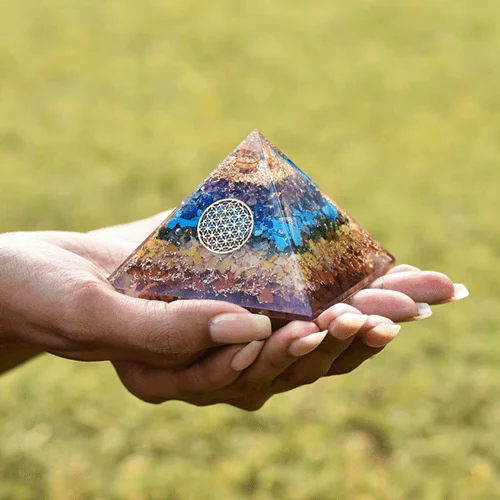
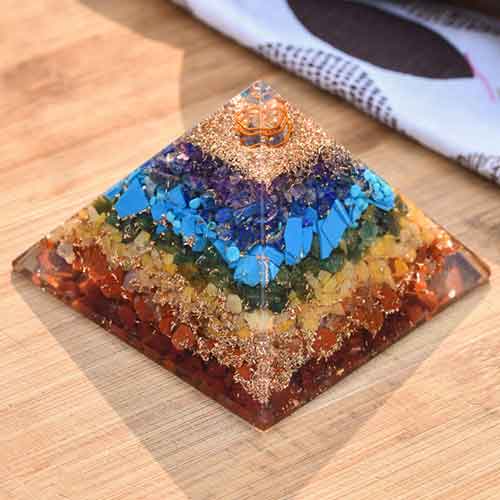

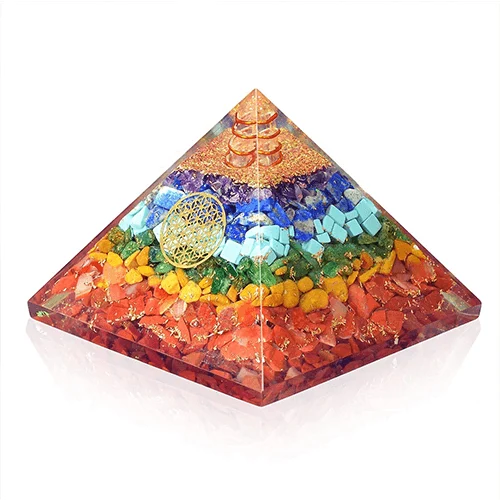
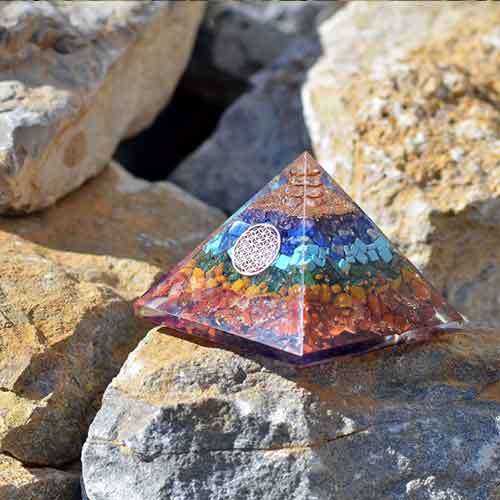
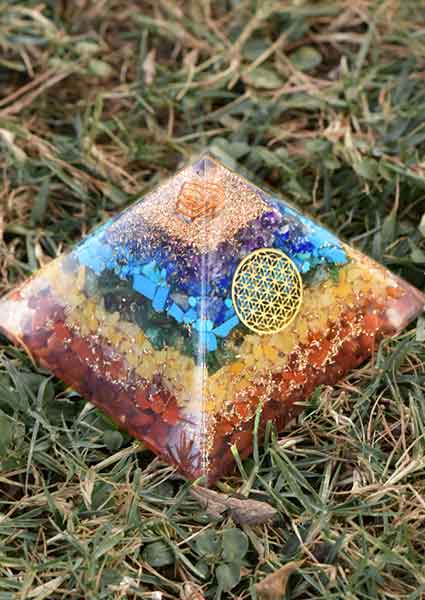




Protective Seven Chakras Orgonite Pyramid
30.67€
Balance and harmony
In stock
Protective Seven Chakras Orgonite Pyramid
Orgonite pyramids are a unique and powerful tool designed to cleanse, balance and amplify the vital energy in the space around you. Every component in these pyramids is carefully selected to contribute to the harmony and well-being of your soul and body.
1. The Life Force of Orgonite: Orgonite is a combination of resin, metals and crystals that work together to filter and balance the flow of energy. Orgonite neutralizes harmful energies and transforms them into positive vibrations.
2. Sacred Geometry: The pyramid shape is a sacred symbol that represents the path to heaven and perfection. It harmonizes, balances and concentrates energy, which makes pyramids especially powerful in spiritual practice.
3. Choice of Crystals: Each of the offered orgonite pyramids can be combined with different crystals such as Rose Quartz, Lapis Lazuli, Tourmaline, Turquoise, Citrine, Peridot and others, to meet your specific needs and goals.
4. Aesthetics and Quality: Each set is carefully packed in an elegant box and offers a visual impression that complements its energetic properties.
5. Versatile Use: Orgonite pyramids can be used both for meditation and healing, as well as a unique decorative element in the home or office.
Discover the magic and power of orgonite pyramids and choose the one that best matches your energetic needs. These pyramids are not only beautiful and refined, but also serve as a constant source of positive energy and protection.
The word “Orgone” means life force or vital energy. Orgone pieces are mixtures of resin, metals and crystals compressed into different shapes.
Few people realize that there is more than magic in pyramids. Unlike many other tools and methods, the effect of pyramids has been scientifically proven. Pyramids are among the most powerful symbols of sacred geometry. They are associated with the path to heaven. All types of pyramids, and especially pyramids with the proportions of the Great Pyramid of Giza, are associated with sunlight and life-giving energy.
The pyramid is the best means of neutralizing harmful waves. The pyramid harmonizes, balances and transforms any energy.
Scale models of the Great Pyramid are known for the extraordinary properties attributed to them. More than 100 phenomena are associated with them – meat placed in such a model does not spoil, a used razor blade left for several hours in a scale model sharpens itself, sour wine restores its taste, and so on. Perhaps the most valuable quality attributed to scale models of the Great Pyramid is their ability to neutralize harmful geopathogenic radiation. There are different ways to neutralize geopathogenic radiation, but the use of scale models of the Great Pyramid is considered the most effective.
But beyond protection, the benefits that a scale model of the Great Pyramid may give you are said to be much greater. It may help you attract positive vibrations.
The orgonite pyramid is a powerful transformer that draws in all negative energies and influences near the place where it is positioned. From the moment you touch it, you will feel its beneficial, transforming power. Orgonites in the shape of a regular pyramid are believed to have the unique ability to transform negative energy from the space by converting it into positive, healthy energy that brings good events.
The use of crystals and minerals gives individuality and strength to each pyramid.
The metal elements and high-quality epoxy resin are also of particular importance. The dimensions and proportions of the pyramid are also extremely important. A clear quartz crystal in the upper part of the pyramid is also essential.
The pyramids we offer and handcraft have a square base – 8 cm x 8 cm. The number 8 is a very special number in numerology. It symbolizes infinity and the connection between heaven and earth.
- We also used another special symbol – the “Flower of Life”, one of the most powerful symbols of sacred geometry.
For the creation of the pyramid we chose:


- 1st chakra – Root (Muladhara) – Red Jasper
- 2nd chakra – Sacral (Svadhisthana) – Carnelian
- 3rd chakra – Solar Plexus (Manipura) – yellow Aventurine
- 4th chakra – Heart (Anahata) – Aventurine
- 5th chakra – Throat (Vishuddha) – Turquoise
- 6th chakra – Brow (Third Eye, Ajna) – Lapis Lazuli
- 7th chakra – Crown Chakra (Sahasrara) Amethyst
Attention: jewelry and stones are not a medical treatment and do not cure. Treatment may be carried out only by a practicing medical professional.
What are the chakras?
Explained in the simplest possible way, we could describe chakras as receivers, reservoirs and transformers of energy. Energy – the most valuable resource in the Universe! Chakra in Sanskrit means wheel, and Indians describe chakras as spinning wheels of light and color. Chakras are special centers in which bioenergy is received, processed, stored and emitted. The energy gathered in the chakras is distributed through 14 central channels (meridians) and a complex network of channels resembling the nervous system (around 64,000) to the organs.
The proper functioning of these centers is at the foundation of our health, psychological state and vitality. Any disturbance in the activity of the chakras is considered a cause of reduced human vitality and the development of various illnesses. There are many reasons why chakra function may be disturbed. The most common and dangerous causes of chakra blockages are stress, negative emotions, poor nutrition, distance from nature, radiation from modern technologies and so on.
1st chakra – Root (Muladhara)
Mantra: Lam
Color: red
Location: tailbone
Physical sense: smell
Organs and endocrine glands: colon and rectum, male reproductive organs, prostate, all bone formations – bones, teeth, nails; tailbone; spine, skeleton, lower limbs.
Emotional manifestations of chakra imbalance:
Overactive: fear, nervousness, panic, lack of stability, excessive forcing, unnecessary struggle for survival, tendency toward promiscuity, egocentrism.
Underactive: depression, exhaustion, lethargy, melancholy, inactivity, strong resistance to change.
Physical manifestations of chakra imbalance: hemorrhoids, constipation, sciatica, prostate disease, depression, neuralgia, paralysis, infertility, circulation problems, joint and bone problems.
Stones and crystals that help balance the chakra and subsequently treat illnesses associated with it: jet, garnet, morion, obsidian, onyx, smoky quartz, ruby, heliotrope, hematite, red coral, red jasper, black tourmaline.
2nd chakra – Sacral (Svadhisthana)
Mantra: Vam
Color: orange
Location: midway between the navel and pubic bone.
Physical sense: taste
Organs and endocrine glands: female reproductive organs – uterus, ovaries, mammary glands, kidneys, bladder, adrenal glands, all organs and systems connected with fluids in the human body – urinary system, bone marrow, spleen, lymph glands, circulation.
Emotional manifestations of chakra imbalance: insecurity, lack of self-confidence, complexes, dissatisfaction, jealousy, bitterness, envy, selfishness, restraint, promiscuous sex, sexual fantasies, disappointment with oneself and feelings of guilt.
Physical manifestations of chakra imbalance: impotence, frigidity, hypersexuality, infertility, diseases of the reproductive organs, benign or malignant growths, cancer of the uterus or male reproductive organs, kidney stones.
Stones and crystals that help balance the chakra and subsequently treat illnesses associated with it: carnelian, coral, orange jasper, orange agate, heliotrope, amber.
3rd chakra – Solar Plexus (Manipura)
Mantra: Ram.
Color: yellow.
Location: solar plexus
Physical sense: sight
Organs and endocrine glands: liver, gallbladder, spleen, stomach, pancreas, small intestine, diaphragm, blood vessels, digestive system, assimilation of food through burning in the body.
Emotional manifestations of chakra imbalance: constant anxiety and dissatisfaction, helplessness, doubt, excessive self-criticism, strong feelings of guilt, suppressed anger, tendency to manipulate, excessive ambition, arrogance, stinginess.
Physical manifestations of chakra imbalance: almost all diseases of the digestive system – ulcer, gastritis; hepatitis, gallstones, diabetes, problems with the intestines and pancreas, vision problems.
Stones and crystals that help balance the chakra and subsequently treat illnesses associated with it: yellow topaz, yellow tourmaline, amber, malachite, peridot, pyrite, native gold, sunstone, tiger’s eye, jadeite, yellow agate, citrine.
4th chakra – Heart (Anahata)
Mantra: Pam
Color: green and pink
Location: in the heart area, midway along the line connecting the two nipples.
Physical sense: touch
Organs and endocrine glands: heart, lungs, thymus, circulatory system, lungs, breathing, mammary glands, upper back, skin.
Emotional manifestations of chakra imbalance: cruelty, hard-heartedness, insensitivity toward others, mistrust, ingratitude, sadness, excessive passivity.
Physical manifestations of chakra imbalance: various cardiovascular diseases, hypertension, arthritis, lung diseases, asthma, respiratory illnesses, paralysis, weak immune system.
Stones and crystals that help balance the chakra and subsequently treat illnesses associated with it: aventurine, jade, green tourmaline, nephrite, malachite, rhodonite, rhodochrosite, rose quartz, pink tourmaline, emerald.
5th chakra – Throat (Vishuddha)
Mantra: Ham
Color: light blue
Auric body: lower spiritual
Location: at throat level (thyroid gland)
Physical sense: hearing
Organs and endocrine glands: activity of the thyroid and parathyroid glands, nerve centers of the larynx and pharynx, breathing, voice, balance and hearing.
Emotional manifestations of chakra imbalance: suppression, unsociability, dissatisfaction, backwardness, mania, self-promotion, talkativeness, gossiping, inability to listen.
Physical manifestations of chakra imbalance: thyroid disease, frequent inflammation of the throat, infections and diseases of the larynx, hearing and speech problems – stuttering, lung infections, tension in the neck muscles, problems with the arms.
Stones and crystals that help balance the chakra and subsequently treat illnesses associated with it: aquamarine, amazonite, lapis lazuli, blue agate, sodalite, turquoise, chrysocolla.
6th chakra – Brow (Third Eye, Ajna)
Mantra: Om
Color: indigo
Location: between the two eyebrows, the third eye
Physical sense: all senses
Organs and endocrine glands: pituitary gland and brain, cerebral cortex, subcortical centers, cerebellum, hypothalamus, pituitary gland, emotions, will, psyche and intuition.
Emotional manifestations of chakra imbalance: intellectual stagnation, problematic and difficult concentration.
Physical manifestations of chakra imbalance: all endocrine glands and related organs, mental instability, mental disorders, schizophrenia, sleepwalking.
Stones and crystals that help balance the chakra and subsequently treat illnesses associated with it: amethyst, lapis lazuli, moonstone, blue sapphire, sodalite, sugilite, fluorite.
7th chakra – Crown Chakra (Sahasrara)
Mantra: Aum
Color: all colors of the rainbow, predominantly gold and purple
Location: center of the crown of the head
Physical sense: none (all)
Organs and endocrine glands: pineal gland, brain, nervous activity of the brain centers
Emotional manifestations of chakra imbalance: fear psychoses, depression, pathological self-contemplation.
Physical manifestations of chakra imbalance: impaired cerebral circulation, increased intracranial pressure, cerebral edema, tumors, strokes.
Stones and crystals that help balance the chakra and subsequently treat illnesses associated with it: amethyst, diamond, moonstone, moss agate, pyrite, clear quartz, selenite,
Attention – stones are not a medical treatment. Such treatment may be prescribed only by a practicing physician.
| Weight | 0.180 kg |
|---|---|
| Materials | Metal, Natural Stone, Polyester cord, Resin |
| Designer | Kremena, Selena Fashion |
| Color | Blue, Gold, Green, Pink, Red, Silver, Transparent, Yellow |
| stone | Amethyst, Aventurine, Carnelian, Citrine, Clear Quartz, Jasper, Lapis Lazuli, Turquoise |
Choosing the right jewelry size is essential for both comfort and appearance.
This is also one of the questions I am asked most often.
Whether it is a bracelet, ring or necklace, the right size makes the difference between “it fits” and “wow.”
In this guide, we will show you easy ways to measure your size at home – quickly and without special tools.
How to Measure Your Bracelet Size

Method 1: Using a Measuring Tape
Wrap the measuring tape around your wrist (exactly where you wear your bracelet)
Do not pull it too tight – it should feel comfortable
Note the measurement
Add:
- +1 cm for a closer fit
- +1.5–2 cm for a looser fit

Method 2: Using String or Ribbon
Wrap a piece of string around your wrist
Mark where the ends meet
Measure the length with a ruler
💡 Tip: If the bracelet is made with natural stones, it is better to choose a slightly looser size.
How Bracelet Type Affects Size
Elastic Bracelet
The most comfortable and versatile option
Stretches slightly when putting it on
Fits more closely around the wrist
If the bracelet is too small, it will feel tight and may leave marks on your wrist. It may even cause discomfort such as numbness because it restricts circulation. A bracelet that is too tight will also wear out and break more quickly.
If it is too large, it may slip off.
Recommendation: Choose +1 cm so it does not feel tight and remains comfortable
Bracelet with a Clasp
Does not stretch
Has a more structured, classic jewelry look
Requires a more precise fit with minimal extra room. We will make the bracelet with several extension rings for adjustment.
Recommendation: Choose +1.5–2 cm for comfortable freedom of movement
Shamballa / Adjustable Bracelet
Can be tightened or loosened
Suitable as a gift (less risk of choosing the wrong size)
Has a more relaxed fit on the wrist
Recommendation: Choose the closest size to the fit you want (for example 17–18 cm), because it can be adjusted
Practical tip: If the bracelet is made with larger stones (8 mm and above), add another ~0.5 cm – larger beads add volume and make the bracelet feel tighter.
Create your bracelet your way – for most of our designs, you can now choose an elastic bracelet, a clasp fastening or an adjustable Shamballa style
How to Measure Your Ring Size
There is a wide range of ring sizes.
Method 1: Using String or a Paper Strip
Wrap it around your finger
Mark where the ends meet
Measure in mm – ring sizing requires greater precision than bracelet sizing.
Method 2: Using a Ring You Already Own
Take a ring that fits you well
Measure the inside diameter
Compare it with a standard size chart
Important: Fingers can swell during the day → measure in the evening for the most accurate result.
Standard Ring Size Chart
| Finger circumference (mm) | Inside diameter (mm) | Size (EU) | Size (US) |
|---|---|---|---|
| 44.2 | 14.1 | 44 | 3 |
| 46.1 | 14.7 | 46 | 3.5–4 |
| 47.4 | 15.1 | 47 | 4 |
| 48.0 | 15.3 | 48 | 4.5 |
| 49.3 | 15.7 | 49 | 5 |
| 50.0 | 15.9 | 50 | 5–5.5 |
| 51.2 | 16.3 | 51 | 5.5–6 |
| 52.5 | 16.7 | 52 | 6 |
| 53.1 | 16.9 | 53 | 6.5 |
| 54.4 | 17.3 | 54 | 7 |
| 55.1 | 17.5 | 55 | 7–7.5 |
| 56.3 | 17.9 | 56 | 7.5 |
| 57.0 | 18.1 | 57 | 8 |
| 58.3 | 18.5 | 58 | 8.5 |
| 59.5 | 19.0 | 59 | 9 |
| 60.2 | 19.2 | 60 | 9–9.5 |
| 61.4 | 19.6 | 61 | 9.5 |
| 62.1 | 19.8 | 62 | 10 |
| 63.4 | 20.2 | 63 | 10.5 |
| 64.0 | 20.4 | 64 | 11 |
| 65.3 | 20.8 | 65 | 11–11.5 |
| 66.6 | 21.2 | 66 | 11.5 |
| 67.2 | 21.4 | 67 | 12 |
| 68.5 | 21.8 | 68 | 12.5 |
| 69.7 | 22.2 | 69 | 13 |
How to Use the Chart
- If you measure with string → use the circumference (mm)
- If you have a ring → use the inside diameter
- In Bulgaria, EU sizing is used most commonly (e.g. 52, 54, 56)
A Small Practical Tip (Very Important)
- Measure in the evening – fingers are usually slightly more swollen
- If you are between two sizes → choose the larger one
- For wider bands → choose one size larger
How to Choose a Necklace Length
Standard lengths:
35–40 cm → choker (close around the neck)
45 cm → classic length
50–60 cm → a longer, looser necklace
Tip: If you layer necklaces, combine different lengths for a more striking look.

How to Measure Your Anklet Size

How to Measure
Wrap a measuring tape or string around your ankle
Measure exactly where you want the anklet to sit
Note the circumference
Add to the measurement:
- +1–1.5 cm → a closer fit (elegant and close to the skin)
- +2–2.5 cm → a looser fit (relaxed summer look)
Type of Anklet
Elastic
- Fits more closely
- More comfortable for everyday wear
Choose: +1–1.5 cm
With a Clasp
- Does not stretch
- Has a more elegant look
Choose: +2 cm
Adjustable (Shamballa / sliding closure)
- Can be adjusted
- Suitable as a gift
Choose a more precise size
Important: The ankle can swell during the day (especially in summer) → measure in the evening
If you are between two sizes, choose the larger one.
Slightly loose is better than uncomfortably tight.
For Handmade Jewelry
Every piece of jewelry is unique, especially when natural stones are used.
Small variations in size are completely normal and part of their charm.


Reviews
There are no reviews yet.