


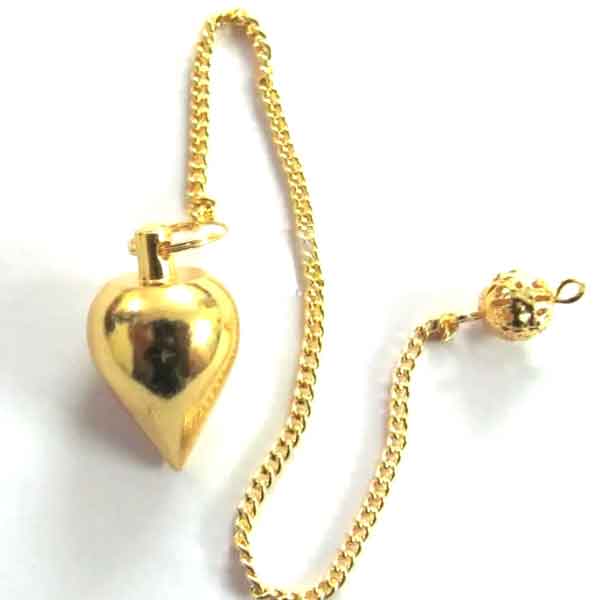

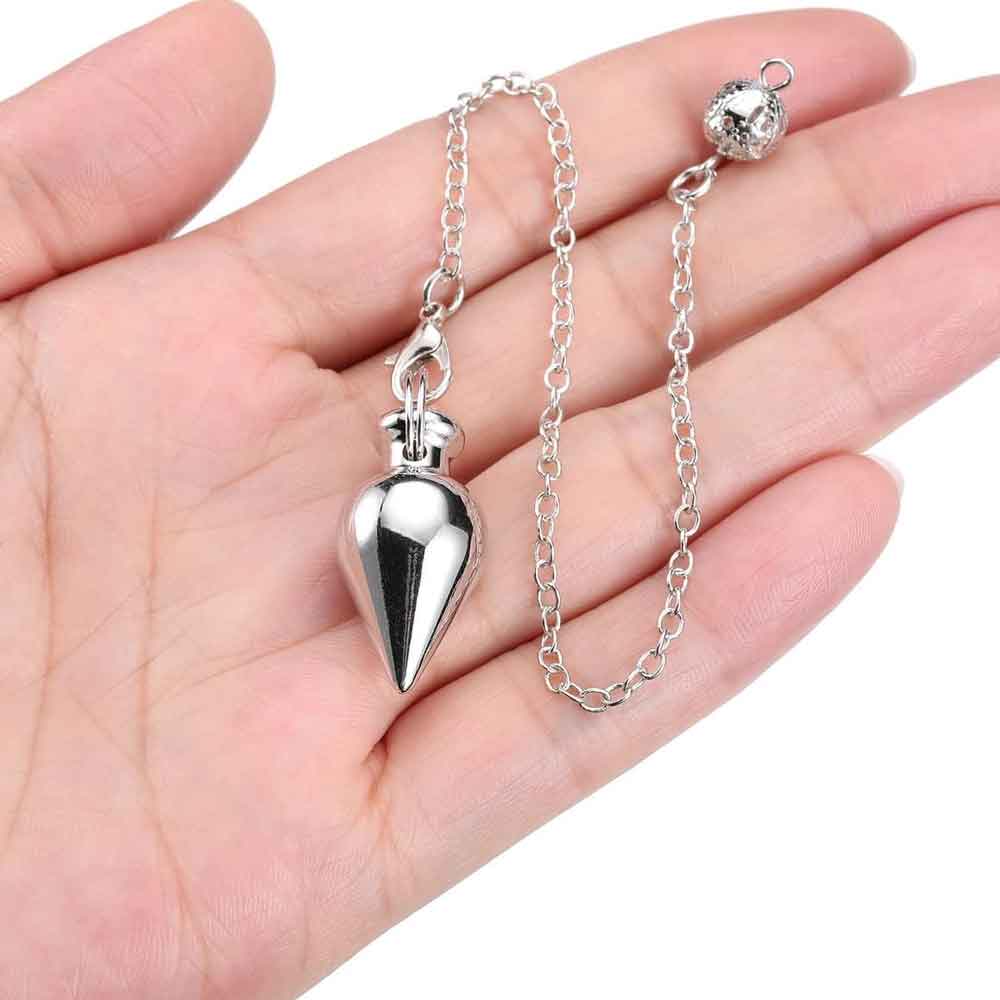




Multifunctional Metal Dowsing Pendulum “Crystal Tear”
Original price was: 12.73€.10.22€Current price is: 10.22€.
Conical radiesthesia pendulum, opening metal design
Multifunctional Metal Dowsing Pendulum “Crystal Tear”
These pendulums are exceptionally suitable for both beginners and advanced practitioners.
“Crystal Tear” is a captivating pendulum distinguished by its multifunctionality and elegant design. It is suitable for a wide range of purposes, including divination, dowsing, energy cleansing, crystal healing, meditation, chakra balancing, creating crystal grids, Reiki, Feng Shui, and it is also beautiful as jewelry, ideal as a gift, and much more.
“Crystal Tear” is made of copper and its dimensions make it convenient to carry and use. The total length (chain with bead and pendulum) is approximately 22.86 cm, while the pendulum itself measures 28 x 14 mm.
This pendulum is ideal for people seeking direct answers to questions, locating people or objects, cleansing energy and, above all, enhancing spirituality. Light and discreet, it can practically always stay with you.
Please note that the actual pendulum may differ slightly from the photo due to variations in brightness, resolution, contrast, etc.
Radiesthesia, also known as dowsing, is an ancient practice said to date back to around 8000 BC. It has been used by many cultures, including Jews, Egyptians, Chinese, Romans, Greeks, Druids, Hindus, Peruvians and Native Americans. Even the Bible contains references to Moses as a “water diviner” who found water with a willow rod.
Radiesthesia is associated with identifying and measuring different types of radiation or emanations – inorganic, plant, animal or human. Divination combines dowsing and radiesthesia, extending the boundaries of knowledge beyond the sensory abilities.
A pendulum is a tool that serves as an external expression of intuition. It can be made from different materials and come in a variety of shapes. It is important to choose a pendulum that feels comfortable and suits the individual needs of the practitioner.
The most widely used instrument in radiesthesia is the radiesthesia pendulum. It consists of a weight with a specific shape and a thread or chain attached at one end. The working technique is approximately as follows: hold the thread so that the pendulum hangs freely. Mentally ask the question that interests you. If the answer is “yes,” the pendulum turns to the right. If the answer is “no,” it turns to the left. Of course, the pendulum follows the individual rhythm of the person, which is why there are many exceptions.
For most people, clockwise movement of the pendulum corresponds to “yes,” while counterclockwise movement corresponds to “no.” For a smaller group, the movements are mirrored: clockwise means “no,” counterclockwise means “yes.” These are sometimes referred to as left-oriented dowsers. This does not mean that these people are left-handed in everyday life. If you belong to this group, there is no cause for concern. Once you know the correct meaning of the responses you receive from the pendulum from the beginning, you should have no difficulty in your further practice.
In rare cases, linear responses occur – forward and backward for “yes,” left and right for “no.” In other cases, circular movement means “yes,” while no movement at all means “no.” This is said to occur only in a very small number of people, so we mention it simply as a possibility.
Unlike many “magical” rituals, anyone can learn to use a pendulum with some training and patience. The principle is described as being based on natural physical phenomena such as radiations and waves.
Pendulums differ in type, shape and purpose – and, like people, most are unique. Write to us and we will consult a radiesthesia specialist about which pendulum is most suitable for you.
If you are a beginner, it is a good idea to choose a universal pendulum – conical, teardrop-shaped or hemispherical.
A pendulum may be used in dowsing traditions to locate underground water, assess health-related questions, explore nuances in interpersonal relationships, make business forecasts, and more.
Choosing the right jewelry size is essential for both comfort and appearance.
This is also one of the questions I am asked most often.
Whether it is a bracelet, ring or necklace, the right size makes the difference between “it fits” and “wow.”
In this guide, we will show you easy ways to measure your size at home – quickly and without special tools.
How to Measure Your Bracelet Size

Method 1: Using a Measuring Tape
Wrap the measuring tape around your wrist (exactly where you wear your bracelet)
Do not pull it too tight – it should feel comfortable
Note the measurement
Add:
- +1 cm for a closer fit
- +1.5–2 cm for a looser fit

Method 2: Using String or Ribbon
Wrap a piece of string around your wrist
Mark where the ends meet
Measure the length with a ruler
💡 Tip: If the bracelet is made with natural stones, it is better to choose a slightly looser size.
How Bracelet Type Affects Size
Elastic Bracelet
The most comfortable and versatile option
Stretches slightly when putting it on
Fits more closely around the wrist
If the bracelet is too small, it will feel tight and may leave marks on your wrist. It may even cause discomfort such as numbness because it restricts circulation. A bracelet that is too tight will also wear out and break more quickly.
If it is too large, it may slip off.
Recommendation: Choose +1 cm so it does not feel tight and remains comfortable
Bracelet with a Clasp
Does not stretch
Has a more structured, classic jewelry look
Requires a more precise fit with minimal extra room. We will make the bracelet with several extension rings for adjustment.
Recommendation: Choose +1.5–2 cm for comfortable freedom of movement
Shamballa / Adjustable Bracelet
Can be tightened or loosened
Suitable as a gift (less risk of choosing the wrong size)
Has a more relaxed fit on the wrist
Recommendation: Choose the closest size to the fit you want (for example 17–18 cm), because it can be adjusted
Practical tip: If the bracelet is made with larger stones (8 mm and above), add another ~0.5 cm – larger beads add volume and make the bracelet feel tighter.
Create your bracelet your way – for most of our designs, you can now choose an elastic bracelet, a clasp fastening or an adjustable Shamballa style
How to Measure Your Ring Size
There is a wide range of ring sizes.
Method 1: Using String or a Paper Strip
Wrap it around your finger
Mark where the ends meet
Measure in mm – ring sizing requires greater precision than bracelet sizing.
Method 2: Using a Ring You Already Own
Take a ring that fits you well
Measure the inside diameter
Compare it with a standard size chart
Important: Fingers can swell during the day → measure in the evening for the most accurate result.
Standard Ring Size Chart
| Finger circumference (mm) | Inside diameter (mm) | Size (EU) | Size (US) |
|---|---|---|---|
| 44.2 | 14.1 | 44 | 3 |
| 46.1 | 14.7 | 46 | 3.5–4 |
| 47.4 | 15.1 | 47 | 4 |
| 48.0 | 15.3 | 48 | 4.5 |
| 49.3 | 15.7 | 49 | 5 |
| 50.0 | 15.9 | 50 | 5–5.5 |
| 51.2 | 16.3 | 51 | 5.5–6 |
| 52.5 | 16.7 | 52 | 6 |
| 53.1 | 16.9 | 53 | 6.5 |
| 54.4 | 17.3 | 54 | 7 |
| 55.1 | 17.5 | 55 | 7–7.5 |
| 56.3 | 17.9 | 56 | 7.5 |
| 57.0 | 18.1 | 57 | 8 |
| 58.3 | 18.5 | 58 | 8.5 |
| 59.5 | 19.0 | 59 | 9 |
| 60.2 | 19.2 | 60 | 9–9.5 |
| 61.4 | 19.6 | 61 | 9.5 |
| 62.1 | 19.8 | 62 | 10 |
| 63.4 | 20.2 | 63 | 10.5 |
| 64.0 | 20.4 | 64 | 11 |
| 65.3 | 20.8 | 65 | 11–11.5 |
| 66.6 | 21.2 | 66 | 11.5 |
| 67.2 | 21.4 | 67 | 12 |
| 68.5 | 21.8 | 68 | 12.5 |
| 69.7 | 22.2 | 69 | 13 |
How to Use the Chart
- If you measure with string → use the circumference (mm)
- If you have a ring → use the inside diameter
- In Bulgaria, EU sizing is used most commonly (e.g. 52, 54, 56)
A Small Practical Tip (Very Important)
- Measure in the evening – fingers are usually slightly more swollen
- If you are between two sizes → choose the larger one
- For wider bands → choose one size larger
How to Choose a Necklace Length
Standard lengths:
35–40 cm → choker (close around the neck)
45 cm → classic length
50–60 cm → a longer, looser necklace
Tip: If you layer necklaces, combine different lengths for a more striking look.

How to Measure Your Anklet Size

How to Measure
Wrap a measuring tape or string around your ankle
Measure exactly where you want the anklet to sit
Note the circumference
Add to the measurement:
- +1–1.5 cm → a closer fit (elegant and close to the skin)
- +2–2.5 cm → a looser fit (relaxed summer look)
Type of Anklet
Elastic
- Fits more closely
- More comfortable for everyday wear
Choose: +1–1.5 cm
With a Clasp
- Does not stretch
- Has a more elegant look
Choose: +2 cm
Adjustable (Shamballa / sliding closure)
- Can be adjusted
- Suitable as a gift
Choose a more precise size
Important: The ankle can swell during the day (especially in summer) → measure in the evening
If you are between two sizes, choose the larger one.
Slightly loose is better than uncomfortably tight.
For Handmade Jewelry
Every piece of jewelry is unique, especially when natural stones are used.
Small variations in size are completely normal and part of their charm.


Reviews
There are no reviews yet.