

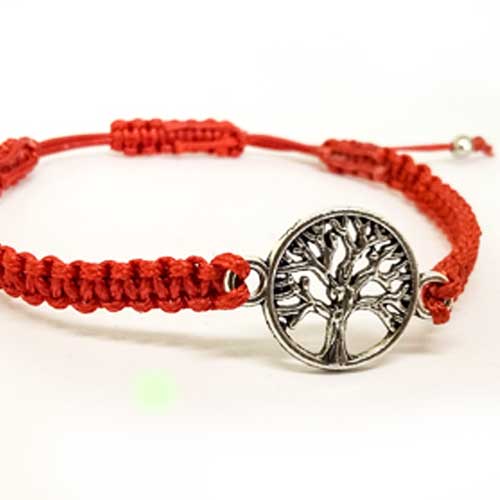
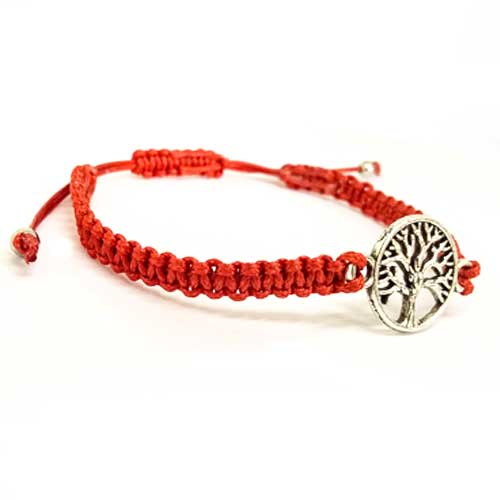
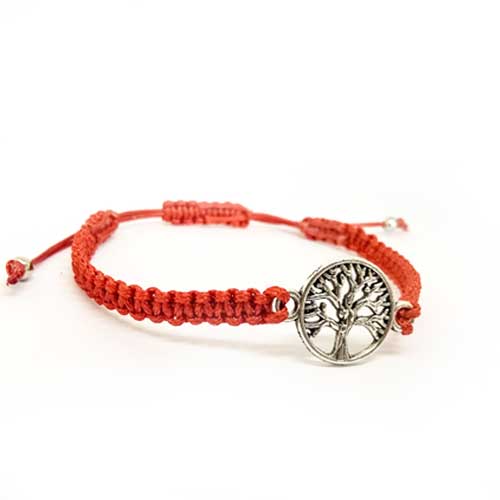
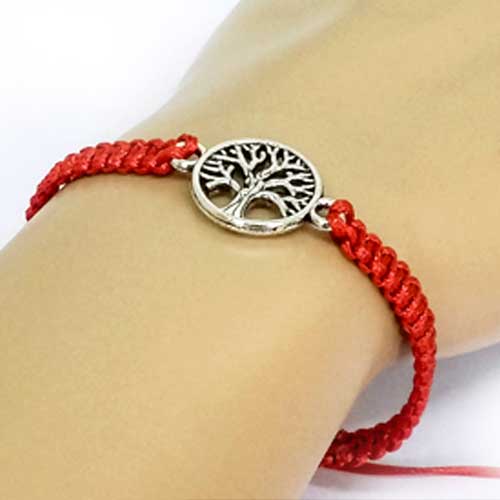
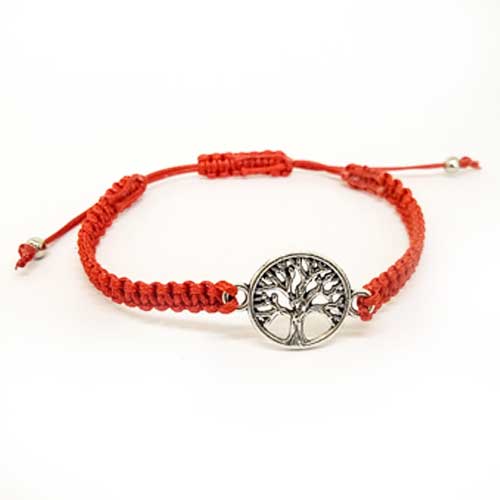


Tree of Life, Evil Eye Protection
Original price was: 8.17€.6.97€Current price is: 6.97€.
Tree of Life, Handmade Evil Eye Protection Bracelet, Shamballa Weave
In stock
Tree of Life, Handmade Evil Eye Protection Bracelet, Shamballa Weave
Red Thread bracelets against the evil eye – protect against negative energy, help in achieving desired goals and are an ancient method.
All of us have experienced being affected by the evil eye.
One of the most time-tested ways to protect yourself from the evil eye or ill-intentioned people is to wear a red thread or red-thread bracelet together with a protective talisman.
As a rule, the bracelet is tied on the person’s left wrist. The evil eye bracelet is also worn on the left wrist.
It must be red, because red is believed to counteract negative energy and harmful intentions.
Tree of Life
is a symbol of life, power, longevity, generosity, patience and protection. Its symbolism and veneration reflect the deification of nature. Every culture has its own Tree of Life, and every god has a sacred tree.
It is hardly a coincidence that throughout the world one can see trees transformed into shrines, decorated with various totems, talismans, threads, pieces of cloth and garlands of flowers.
For many peoples, the tree is an image of the world and of the world axis around which the universe is organized. Such is Ceiba or Yaxche tree, which according to the Maya grows at the center of the world and supports the layers of heaven. They believed that in each of the four regions of the world, one such tree rose like a cornerstone pillar of the firmament. Yggdrasil, the cosmic tree of the Scandinavians, was an enormous ash tree. Every day the gods gathered in council beneath its shade. For the Phoenicians, the cypress was the Tree of Life.
The tree embodies the union between the earth, into which it sends its roots and from whose riches it feeds, the water it absorbs and releases, the air into which it stretches its leaves, and the fire of the sun under which it grows and bears fruit. It is also a symbol of diversity within unity, with its many branches emerging from one root and returning once again to the one – the seed from the fruit of the branches, from which a new tree will be born. The whole is manifested within it, because its roots are in the earth while its branches reach toward the sky, thus joining the two worlds into one – just as in the human being. The tree also symbolizes the feminine principle, the Great Mother – nature, the source of life in all its forms. That is why it is often depicted as a stylized female figure. The evergreen tree represents eternal life, the immortal spirit and eternity. The deciduous tree, which changes through the seasons, is a symbol of the constantly changing and renewing world – life, death, resurrection, reproduction and the life-giving principle.
The Tree of KnowledgeIn the Christian paradise grows the forbidden Tree of Knowledge. The Christian cross was later made from its trunk, and from then on it became the Tree of Life. In “Genesis” it is not specified what kind of tree the Tree of Knowledge was, and this allowed a certain freedom of interpretation among different peoples. Italians and Greeks hesitated between the fig and the orange tree, while the French chose the apple tree. But it is certain that it was a true Tree of Knowledge especially for Newton, who formulated his idea of universal gravitation beneath it.
The tree carries the symbolism of resurrection, because in autumn its leaves fall and in spring new life sprouts from its bare branches. It carries this meaning as well when the changes of its annual cycle are depicted in Christian iconography. When barren or withered, it represents the sinner.
The tree also plays an important role in other religions. Indian ascetics and holy men, sadhus, gather beneath the enormous crowns of banyan trees, where small shrines are often built. Buddha attained enlightenment beneath the Bodhi tree, and it became a symbol of great spiritual growth.
According to Islam, the names of people are written on the leaves of the universal tree, and the angel of death gathers the leaves that fall by Allah’s will and takes away those destined to die. From a tree, the Egyptian goddess Hathor offered drinks and food to the dead or to their flying souls for sustenance. The Sumerian god of vegetation Tammuz was also revered as a Tree of Life. For the ancient Germanic peoples, the oak was the sacred tree of the thunder god, and for the ancient Greeks it belonged to the supreme god Zeus.
Every people has its own preference for a particular tree. In China, the peach tree is especially revered as a symbol of longevity and immortality. In East Asia, the pine is also a Tree of Life, remaining fresh and green even at an advanced age. The most traditional symbol of wisdom and peace is the olive tree, while laurel wreaths are famously used to crown victors. The cedar, whose rot-resistant wood was used to build Solomon’s Temple, is a symbol of strength, nobility and imperishability.
Palm TreeIn Egypt, the palm is a symbol of happiness, abundance and fertility and can often be seen in the hands of the goddess Isis. The Greeks gave palm branches to victors; with palm branches and cries of “Hosanna!” Jesus was welcomed into Jerusalem, and they became a symbol of spiritual triumph.
And all fruit-bearing trees are sacred everywhere. It is no coincidence that they are also present in the paradise of every religion.
Shamballa Weave
Shamballa (Tibetan: བདེ་འབྱུང་) is a mysterious land believed by most legends to be located somewhere in the Himalayas. It is also known as Agartha. In Chinese, Russian and Tibetan myths it is described as a dwelling place of superhuman beings, similar to Blavatsky’s Secret Masters. In early Buddhist texts, Shamballa is mentioned as a source of esoteric wisdom. There are many myths about its location. The Chinese point to Mount Kunlun, while traditions from the Middle East point to the Altai Mountains.
In early Buddhist texts, Shamballa is mentioned as a source of esoteric wisdom, a place of supreme harmony where absolute virtue, peace and tranquility reign. This mysterious land is considered the homeland of the mystical Tibetan Shamballa bracelets. Peter Deunov, Nicholas Roerich, Helena Roerich, Ernst Muldashev and Jan van Helsing have spoken of the mysterious Shamballa as a real place.
Shamballa bracelets are believed to represent an ancient Tibetan ornament worn by Buddhist monks in monasteries of the Far East and used during meditation to attain supreme harmony.
Tibetan Shamballa bracelets have an intricate weave that today is classified as a macramé technique.
Today Tibetan Shamballa bracelets are extremely popular among celebrities as well. Many Hollywood celebrities wear Shamballa bracelets both as elegant jewelry and as a symbol of inner harmony, spiritual peace and the achievement of personal goals.
Tibetan Shamballa bracelets should be entirely handmade. They are believed to bring luck and reflect your individual essence.
They are both beautiful jewelry and a talisman associated with strength, peace of mind and love. In Tibet, for centuries they have been regarded as amulets for luck, harmony, health and prosperity of every kind!
| Weight | 0.002 kg |
|---|
Choosing the right jewelry size is essential for both comfort and appearance.
This is also one of the questions I am asked most often.
Whether it is a bracelet, ring or necklace, the right size makes the difference between “it fits” and “wow.”
In this guide, we will show you easy ways to measure your size at home – quickly and without special tools.
How to Measure Your Bracelet Size

Method 1: Using a Measuring Tape
Wrap the measuring tape around your wrist (exactly where you wear your bracelet)
Do not pull it too tight – it should feel comfortable
Note the measurement
Add:
- +1 cm for a closer fit
- +1.5–2 cm for a looser fit

Method 2: Using String or Ribbon
Wrap a piece of string around your wrist
Mark where the ends meet
Measure the length with a ruler
💡 Tip: If the bracelet is made with natural stones, it is better to choose a slightly looser size.
How Bracelet Type Affects Size
Elastic Bracelet
The most comfortable and versatile option
Stretches slightly when putting it on
Fits more closely around the wrist
If the bracelet is too small, it will feel tight and may leave marks on your wrist. It may even cause discomfort such as numbness because it restricts circulation. A bracelet that is too tight will also wear out and break more quickly.
If it is too large, it may slip off.
Recommendation: Choose +1 cm so it does not feel tight and remains comfortable
Bracelet with a Clasp
Does not stretch
Has a more structured, classic jewelry look
Requires a more precise fit with minimal extra room. We will make the bracelet with several extension rings for adjustment.
Recommendation: Choose +1.5–2 cm for comfortable freedom of movement
Shamballa / Adjustable Bracelet
Can be tightened or loosened
Suitable as a gift (less risk of choosing the wrong size)
Has a more relaxed fit on the wrist
Recommendation: Choose the closest size to the fit you want (for example 17–18 cm), because it can be adjusted
Practical tip: If the bracelet is made with larger stones (8 mm and above), add another ~0.5 cm – larger beads add volume and make the bracelet feel tighter.
Create your bracelet your way – for most of our designs, you can now choose an elastic bracelet, a clasp fastening or an adjustable Shamballa style
How to Measure Your Ring Size
There is a wide range of ring sizes.
Method 1: Using String or a Paper Strip
Wrap it around your finger
Mark where the ends meet
Measure in mm – ring sizing requires greater precision than bracelet sizing.
Method 2: Using a Ring You Already Own
Take a ring that fits you well
Measure the inside diameter
Compare it with a standard size chart
Important: Fingers can swell during the day → measure in the evening for the most accurate result.
Standard Ring Size Chart
| Finger circumference (mm) | Inside diameter (mm) | Size (EU) | Size (US) |
|---|---|---|---|
| 44.2 | 14.1 | 44 | 3 |
| 46.1 | 14.7 | 46 | 3.5–4 |
| 47.4 | 15.1 | 47 | 4 |
| 48.0 | 15.3 | 48 | 4.5 |
| 49.3 | 15.7 | 49 | 5 |
| 50.0 | 15.9 | 50 | 5–5.5 |
| 51.2 | 16.3 | 51 | 5.5–6 |
| 52.5 | 16.7 | 52 | 6 |
| 53.1 | 16.9 | 53 | 6.5 |
| 54.4 | 17.3 | 54 | 7 |
| 55.1 | 17.5 | 55 | 7–7.5 |
| 56.3 | 17.9 | 56 | 7.5 |
| 57.0 | 18.1 | 57 | 8 |
| 58.3 | 18.5 | 58 | 8.5 |
| 59.5 | 19.0 | 59 | 9 |
| 60.2 | 19.2 | 60 | 9–9.5 |
| 61.4 | 19.6 | 61 | 9.5 |
| 62.1 | 19.8 | 62 | 10 |
| 63.4 | 20.2 | 63 | 10.5 |
| 64.0 | 20.4 | 64 | 11 |
| 65.3 | 20.8 | 65 | 11–11.5 |
| 66.6 | 21.2 | 66 | 11.5 |
| 67.2 | 21.4 | 67 | 12 |
| 68.5 | 21.8 | 68 | 12.5 |
| 69.7 | 22.2 | 69 | 13 |
How to Use the Chart
- If you measure with string → use the circumference (mm)
- If you have a ring → use the inside diameter
- In Bulgaria, EU sizing is used most commonly (e.g. 52, 54, 56)
A Small Practical Tip (Very Important)
- Measure in the evening – fingers are usually slightly more swollen
- If you are between two sizes → choose the larger one
- For wider bands → choose one size larger
How to Choose a Necklace Length
Standard lengths:
35–40 cm → choker (close around the neck)
45 cm → classic length
50–60 cm → a longer, looser necklace
Tip: If you layer necklaces, combine different lengths for a more striking look.

How to Measure Your Anklet Size

How to Measure
Wrap a measuring tape or string around your ankle
Measure exactly where you want the anklet to sit
Note the circumference
Add to the measurement:
- +1–1.5 cm → a closer fit (elegant and close to the skin)
- +2–2.5 cm → a looser fit (relaxed summer look)
Type of Anklet
Elastic
- Fits more closely
- More comfortable for everyday wear
Choose: +1–1.5 cm
With a Clasp
- Does not stretch
- Has a more elegant look
Choose: +2 cm
Adjustable (Shamballa / sliding closure)
- Can be adjusted
- Suitable as a gift
Choose a more precise size
Important: The ankle can swell during the day (especially in summer) → measure in the evening
If you are between two sizes, choose the larger one.
Slightly loose is better than uncomfortably tight.
For Handmade Jewelry
Every piece of jewelry is unique, especially when natural stones are used.
Small variations in size are completely normal and part of their charm.

